#navbar { visibility: hidden; /*display: none !important; */ height: 1px; } #navbar-iframe { visibility: hidden; /*display: none !important; */ height: 1px; } New tech and everything New tech and Everything...! .comment-body-author { background: #E6E6E6; /* Background color*/ color: #000; /* Text color*/ border-top: 1px dotted #223344;border-bottom: 1px dotted #223344;border-left: 1px dotted #223344;border-right: 1px dotted #223344; margin:0; padding:0 0 0 20px; /* Posotion*/ }

Labels

Wednesday, April 25, 2012

CinemaCon: Warner Bros. Unveils New Dark Knight, Hobbit and Great Gatsby Footage


CinemaCon: Warner Bros. Unveils New Dark KnightHobbitand Great Gatsby Footage


There was a lot of anticipation for today's Warner Bros. presentation, because every year, they really seem to bring their A-game, and coming off the enormous hit of last year's Harry Potter and the Deathly Hallows – Part 2, they got to do their presentation earlier in the week as part of the Opening Day Ceremony. Much of the excitement came from the knowledge that director Christopher Nolan would be bringing something for The Dark Knight Rises to the presentation, since he's always had a lot of respect for exhibitors and theater owners. Also, the buzz broke out earlier in the week that Peter Jackson would show ten minutes of his upcoming The Hobbit: An Unexpected Journey in 3D at a higher frame rate of 48 frames per second, nearly double what's considered the standard.

But first, everyone had to wait over an hour to listen to speeches from MPAA Chairman and CEO, Senator Chris Dodd, and John Fithian, President and CEO of NATO, who had a lot of interesting things to say about the state of the film industry. Probably the most significant revelation was that 20th Century Fox would stop all non-digital film stock distribution in roughly two years and only be releasing their films digitally. 

Once the Warner Bros. presentation began in earnest, Tim Burton started off by showing an extended trailer for his Dark Shadows after bringing Johnny Depp out, who barely said much of anything.

We'll jump right ahead to the movie everyone was looking forward to, The Dark Knight Rises, although Nolan chose instead of showing the trailer or any sort of long clips with dialogue, to just show a series of hand-picked images that he had cut together with music, with some footage we'd seen before either in previous trailers or stills but also some new bits. It was still quite powerful, even if there wasn't enough dialogue to really have any sort of context.


Share/Bookmark

A Cheap Terahertz Camera

A Cheap Terahertz Camera

17 April 2012—In the entire electromagnetic spectrum, one of the most conspicuously inaccessible chunks sits smack dab between radio waves and infrared light. Researchers have been trying for decades to come up with better ways to exploit the little-used terahertz band, which could provide ways to find hidden objects and determine an object’s chemical makeup at a distance.
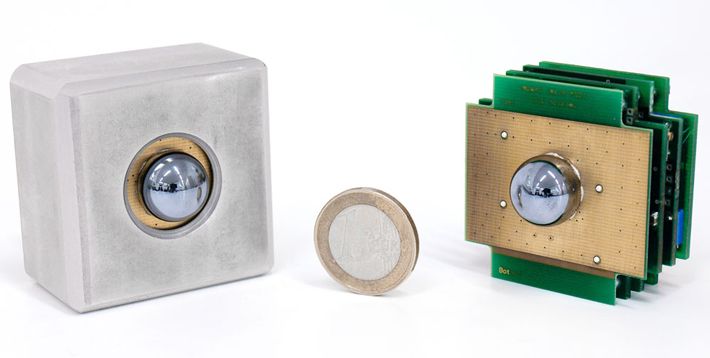
Now a team from IEMN and STMicroelectronics, in France, and the University of Wuppertal, in Germany, has come up with a practical first: a video-rate CMOS camera that’s sensitive to terahertz frequencies.
“I think it’s the hottest thing in terahertz technology at the moment,” says Peter Siegel, who works on terahertz imaging at Caltech and NASA’s Jet Propulsion Laboratory and is not affiliated with the team. “They’ve done a remarkable job of solving a bunch of very pesky problems in working with silicon at high frequencies.”
Up until now, terahertz detectors have tended to be pricey affairs, composed of devices like Schottky diodes or microbolometers. A Schottky diode–based detector  usually contains just one or a few pixels, which are raster-scanned across a scene to slowly form an image. Microbolometers can be arranged in arrays, but they must be cooled to boost their sensitivity.
With just 1024 pixels, this new transistor-based camera is unlikely to give a high-resolution window into the unseen terahertz realm. But the advance has researchers excited, because it suggests terahertz technologies may soon get a lot cheaper and more accessible. The single-pixel terahertz detectors in use now can easily cost as much as US $10 000, Siegel says, so developing a detector that could be mass-produced by chip manufacturers represents a significant advance. “I think you’re going to find a lot of applications opening up that didn’t exist before,” Siegel says.
Building terahertz detectors out of silicon is difficult, because even the best transistors don’t operate well at frequencies in excess of a few hundred gigahertz, the lower edge of the terahertz band. This limitation stems mainly from how fast electrons can shoot from one side of the transistor to the other, resulting in an intrinsic cutoff frequency above which a transistor can’t amplify signals sent into it. “Traditionally, people would say that beyond the cutoff frequency, the transistor wouldn’t work anymore,” says Hani Sherry, a doctoral candidate working at STMicroelectronics. But in 1996, device physicists Michel Dyakonov (now at the University of Montpellier, in France) and Michael Shur (of Rensselaer Polytechnic Institute, in Troy, N.Y.) argued in a paper that appeared in IEEE Transactions on Electron Devices that the cutoff frequency can be surpassed. Although they will not be able to amplify signals, some types of field-effect transistors can still respond to frequencies above the cutoff frequency due to electromagnetic oscillations within the transistor’s channel. (The channel is the main body of a transistor through which current flows when the transistor is on. It runs between two electrodes—the source and the drain—and is adjacent to a third, the transistor’s gate.)


Share/Bookmark

CISPA: Progress, But Flaws Remain


CISPA: Progress, But Flaws Remain

In response to concerns that CDT and others raised, the House Intelligence Committee has agreed to support several important privacy improvements to the Cyber Intelligence Sharing and Protection Act (CISPA). Other issues we raised—the flow of Internet data directly to the National Security Agency (NSA) and the use of information for purposes unrelated to cybersecurity—are not addressed by the amendments the Committee is supporting.   We support amendments to address these unresolved concerns.  

Improvements Supported by the Committee

1. On the question of intellectual property and whether CISPA is some kind of backdoor SOPA, the Committee made changes in its April 16, 2012 discussion draft that we think should put that issue to rest.

2. On the definition of the information that ISPs and others can share with the federal government ("cyber threat information"), the Committee has agreed to support a proposed amendment making improvements.  In particular, the proposed amendment deletes language that encompassed "information pertaining to the protection of a system or network."  The new definition is limited to "information directly pertaining to" a vulnerability, a threat, an effort to degrade, disrupt or destroy a system or network, or an effort to gain unauthorized access to a system or network.  This is an important change.  We believe it would preclude interpretation of the bill to permit the sharing of entire communications streams with the government.

3. Another concern we raised with respect to the definition of the information that could be shared was whether the reference to "efforts to gain unauthorized access" in the bill's definition of "cyber threat information" could include conduct such as using a social networking site in violations of its terms of service.  The Committee has agreed to support an amendment to make it clear that cybersecurity threats do not include actions solely involving violations of consumer terms of service or licensing agreements.

4. Another improvement the Committee previously made may bring some valuable oversight to the implementation of the bill - the bill includes a provision requiring the Inspector General for the Intelligence Community to conduct an annual review of, and file an unclassified report on, the use of cyber threat information for non-cybersecurity purposes, on other actions taken on the basis of shared information, and on the privacy and civil liberties impact of the information sharing authorized under the bill.


Share/Bookmark

iPhone sales help Apple double profit


iPhone sales help Apple double profit

Apple’s quarterly profit almost doubled, blowing past Wall Street estimates after a jump in iPhone sales soothed fears that the device was past its best days for sharp growth.
Shares in the world's most valuable technology company shot 7 per cent higher after the bell, recouping some losses from the past two weeks that had stemmed from concerns that iPhone sales growth rates could not be maintained.
While iPad sales were a little lighter than expected, fiscal second-quarter revenue jumped to $39.2 billion, 59 per cent more than a year earlier and 6.5 per cent higher than analysts' average forecasts.
Lower-than-expected commodity costs also helped lift margins way above estimates.
"That shows they are able to maintain their pricing without compromising on growth," said Morningstar analyst Michael Holt.
Mr Holt added that this had come even though lower priced competition from Google's Android phones - made by the likes of Motorola Mobility and Samsung Electronics were becoming more compelling.
"The concern was that Apple might sell more older models to be more competitive. That would have shown up in the gross margin. But aggregate gross margin and average revenue per device show that this hasn't happened," he said.
Apple sold 35.1 million iPhones - which account for about half its revenue - in the quarter, outpacing the 30 million or so expected by Wall Street analysts, with pent-up demand for the 4S bolstering revenue for China, Taiwan and Hong Kong five-fold to $7.9 billion.
"International iPhone sales were on fire," Apple Chief Financial Officer Peter Oppenheimer told Reuters in an interview.

Share/Bookmark

iPhone sales defy sceptics


iPhone sales defy sceptics


Apple has trumped sceptics once again by reporting massive iPhone sales.

The world’s most valuable company said it sold 35 million iPhones in the January-to-March quarter, almost twice as many as it sold a year ago and above analyst expectations.

Apple’s stock was down 2% at the close of regular US trading, as investors believed phone companies had reined in iPhone sales. In extended trading, the stock rallied $40.02, or 7.1%, to $600.30.

“They’re delivering the goods much stronger than even the biggest bulls would have thought,” said Brian White, an analyst with Topeka Capital Markets. “It’s Apple fever at its finest.”

Net income in the company’s fiscal second quarter was $11.6bn, or $12.30 per share. That was nearly double the net income of $6bn, or $6.40 per share, a year ago.

Analysts polled by FactSet were expecting earnings of 10.07 dollars per share for the latest quarter, Apple’s fiscal second.

Revenue was $39.2bn, up 59% from a year ago. Analysts were expecting $37bn.

IPad sales came in below analyst expectations, at 11.8 million units. But that was still two and a half times as many as it sold in the same quarter a year ago. Apple launched a new iPad model in the quarter, and supplies are still tight. Mr White believes short supplies of the new high-resolution screen are to blame.

Mac sales were also slightly below expectations, at four million, up 7% from last year. Meanwhile, the overall PC market grew about 2%.

Windows PC makers are now hoping Windows 8 will give them a better chance at competing with Apple, both in PCs and tablets. Intel CEO Paul Otellini said last week he believed PCs and tablets would merge into one light device with a keyboard and a touch-sensitive screen.

But Apple chief executive Tim Cook dismissed that idea on a conference call with analysts yesterday. Tablets and PCs worked best as separate devices, playing to their own strengths, he said.

Read original post>>>

Share/Bookmark

Tuesday, April 24, 2012

Barnes & Noble Nook Simple Touch with GlowLight Review

Barnes & Noble Nook Simple Touch with GlowLight Review

The third-generation Nook looks nearly identical to the graphite Nook Simple Touch, except for a light gray sliver rim around the edge. While the dimensions of the two are the same (6.5 x 5.0 x 0.47 inches), the third generation Simple Touch weighs 6.95 ounces, compared to 7.48 ounces on the previous version. While it may not seem like much, the half-ounce difference makes for more comfortable longer reading sessions, as does the soft-coated, rubbery contours of the backside.
The E Ink display, which is slightly inset, features an infrared-controlled touch screen that is generally responsive. The Nook Simple Touch comes with a built-in anti-glare screen protector. We expected it to feel gritty, but we couldn't discern any difference when compared to the E Ink screen on the Kindle Touch.
The Power button still sits on the back at the top, and a stylized N-shaped Menu button sits beneath the front display. Along the right side of the back is a microSD port cover that didn't sit as flush as we'd have liked. Flanking the screen are two rubbery page-turn buttons on each side that were easy to press. Helpfully, in the Settings menu, you can decide if the top or bottom buttons will turn the page forward or back. Whichever button acts as Page Forward will also, when held down, activate Fast Page, miming the act of flipping through the pages of a physical book.


Share/Bookmark

Poker on your iPhone


Poker on your iPhone

If, just for a chance, you decide not to follow every single game of the World Cup, I think I have just found the perfect place for you…..on your Iphone!

Last night, I spent hours on a new poker application on the Iphone and it is great!

I was always a bit cautious about playing poker in casinos or even with friends because I never really knew if I was good at it. I always wondered where all these people were training to become so good. Well, now I found the perfect tool for that my Iphone…

Read more>>>

Share/Bookmark